PERMACHANGE

Hybrid modelling of permafrost terrain stability changes

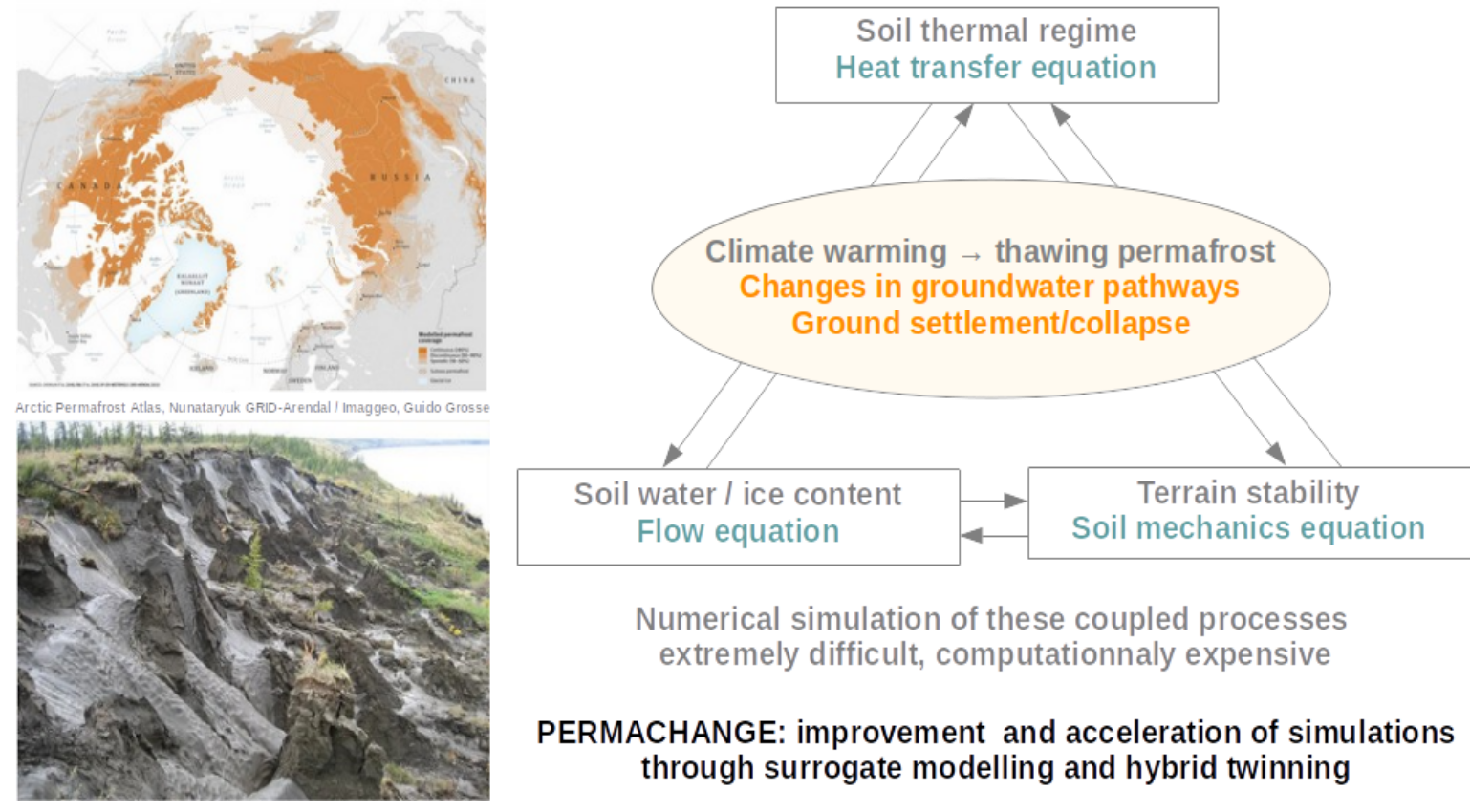
PERMACHANGE is an ANR-funded project, to be active from 2026 to 2029. It deals with advanced modelling of thermo-hydro-mechanical dynamics of permafrost. Permafrost is soil permanently frozen in depth, covering a quarter of Northern Hemisphere lands. Due to climate warming, it is experiencing fast and widespread thawing, and this induces essential impacts in the Arctics, both on the environment (e.g., water resources) and on societies (e.g., infrastructure destabilisation). These permafrost thaw impacts are expected to generate significant additional financial costs for maintaining key human activities, up to hundreds of billions of euros by the end of the century. Moreover, permafrost thaw will likely trigger critical climatic feedback. Thus, anticipating permafrost thaw, by numerical simulations, is paramount for ensuring the resilience of Arctic environments, societies and activities while controlling the associated costs. Meanwhile, numerical simulations of permafrost dynamics are highly complex and challenging due to the strong non-linearities and couplings involved in the related physics. Since this requires extremely fine spatial and temporal discretisation’s, high-performance computing is needed. In the finishing ANR project HiPerBorea (2020-2025, coordinator: L. Orgogozo, ~21 millions of CPU hours allocated by GENCI), a new massively parallel solver (called “permaForm”) for permafrost simulation has been developed (Orgogozo et al., 2023), allowing for the first time the mechanistic simulation of century time scale permafrost evolution at the headwater catchment scale (Xavier et al., 2024). However, an improvement of several orders of magnitudes of performances is necessary for operational applications: the century watershed scale simulations performed in HiPerBorea consumed about half a million CPU hours each. Moreover, for many applications of interest (e.g., infrastructure stability), soil mechanics should be considered alongside underground heat and water transfers, which implies significant additional computational costs. The PERMACHANGE project aims to cross this gap by combining high-performance computing, surrogate modelling, and hybrid modelling to simulate coupled thermal, hydrological and mechanical processes of permafrost terrains.

Contact : Laurent Orgogozo, Associate Professor at Geosciences Environment Toulouse laboratory (email: laurent.orgogozo@get.omp.eu)

News

Non classé

Selection of the PERMACHANGE project by the AAPG 2025 of the ANR

Submitted to the Axis E.05 ‘High Performance Computing, Numerical models, simulation, applications’ of the Generic call for proposals 2025 of the National Research Agency, the PERMACHANGE project has been selected for funding on the 2026-2029 period, with a budget of 573 043 euros. The project is lead by the GET, in partnership with PIMM and […]

Search